
Understanding the Dark Triad Personality Test: Traits, Context, and Careful Benefits
Take Dark Triad Test Online
Get StartedWhy This Controversial Cluster Captivates Audiences
Conversations about socially aversive traits often spark equal parts fascination and concern. Researchers, clinicians, and curious readers want to understand how antagonistic tendencies take shape, why they persist, and when they manifest in daily life. Popular culture adds drama, yet scientific literature emphasizes nuance, measurement, and context. The topic invites rigorous thinking because motivations, behaviors, and outcomes can shift with environment, incentives, and accountability.
Within research and popular discourse alike, the construct of the dark triad of personality sits at the crossroads of curiosity and caution. Scholars probe underlying dispositions such as callousness, manipulativeness, and grandiosity, while also mapping how these traits overlap with normal-range personality dimensions. Rather than glorifying cruelty, responsible analysis examines trade-offs: assertiveness versus empathy, boldness versus recklessness, strategy versus sincerity.
- Evidence-based summaries help separate myth from measurable patterns.
- Contextual factors, power dynamics, norms, and stress, often shape outcomes.
- Ethical guardrails and self-awareness reduce the risk of interpersonal harm.
People come to this subject for different reasons: self-knowledge, leadership development, relationship insight, or pure academic interest. Each path benefits from clear definitions, careful interpretation, and attention to boundaries. With clarity and humility, readers can extract lessons about influence, risk, and responsibility without endorsing exploitation or cruelty.
Core Components and Psychology: Narcissism, Machiavellianism, and Psychopathy
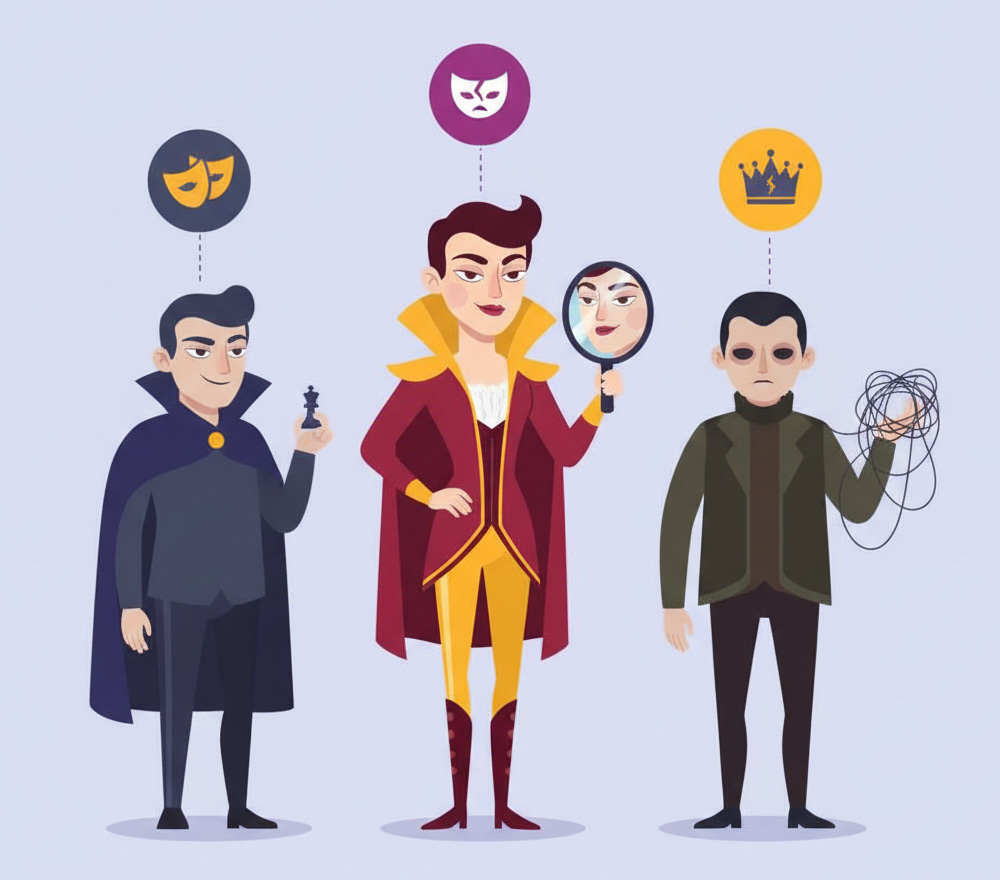
The triad refers to three partially overlapping traits that cluster around antagonism. Narcissism captures entitlement and status hunger alongside fragile self-esteem; Machiavellianism reflects calculated strategy, long-horizon planning, and cynicism about others; psychopathy centers on low fear, impulsivity, and shallow affect. Together, they predict social friction, but they also reveal distinct textures that matter for real-world behavior and intervention.
For many readers, a validated dark triad personality test offers a structured snapshot that complements careful self-reflection. Measurement highlights broad tendencies, not destiny, so results should be read as probabilistic signals rather than verdicts. Where narcissism may energize visibility and ambition, it can also erode collaboration when admiration is withheld. Where Machiavellianism can sharpen strategic thinking, it may corrode trust if honesty is treated as optional. Where psychopathy confers stress immunity, it can risk cavalier decisions under uncertainty.
- Narcissism: agentic drive, sensitivity to status, defensive reactions to criticism.
- Machiavellianism: instrumental social intelligence, preference for indirect influence.
- Psychopathy: low anxiety, sensation seeking, diminished guilt, and impulsive choices.
Scientific work parses traits further into facets, grandiose versus vulnerable narcissism; primary (fearless dominance) versus secondary (impulsive antisociality) psychopathy. Such nuance matters for prediction, feedback, and ethical safeguards. Ultimately, context and choice determine whether sharp edges are channeled into disciplined performance or slide into harm.
Origins, Development, and Real-World Context
Where do antagonistic traits come from, and why do they persist across time and culture? Research points to heritability, early learning, reinforcement history, and ecological pressures. Children who experience inconsistent caregiving, harsh environments, or norms that reward dominance may learn that warmth is costly and vigilance pays. Over time, schemas about trust, control, and fairness can harden into recognizable patterns.
Outside the lab, an engaging dark triad personality quiz can pique interest, yet interpretation still benefits from context and restraint. Workplaces, families, and communities all possess incentive structures that can magnify or mute antagonism. Competitive, zero-sum arenas often reward boldness and strategic secrecy, while collaborative cultures reward empathy and transparency. Understanding this interaction helps explain why the same person can look heroic under pressure, abrasive in team meetings, and charming at a networking event.
- Social norms: expectations around candor, reciprocity, and fairness shape behavior.
- Accountability: transparent feedback and consequences reduce antisocial drift.
- Selection effects: certain roles attract individuals with higher risk tolerance and dominance.
Longitudinal studies suggest that maturation, mentorship, and life roles can soften rough edges. Even then, self-regulation, values clarification, and constructive outlets remain the core ingredients that differentiate disciplined drive from destructive disruption.
Potential Advantages and Ethical Boundaries
Public discussion frequently focuses on harm, but a balanced view also examines adaptive slices under strict ethical constraints. Strategic calm during crises, comfort with difficult trade-offs, and resistance to social pressure can be valuable in settings where hesitation is costly. In high-stakes negotiations, emergency response, or entrepreneurial pivots, composure and goal focus can keep a team moving while emotions surge.
That said, every benefit has a shadow. Composure can become coldness, efficiency can become exploitation, and persuasion can slip into deceit. Responsible channeling starts with explicit norms: honesty as a nonnegotiable, respect as the floor, and transparent oversight as routine. When ambition is tethered to pro-social goals, safety, innovation, public service, risk appetite can be harnessed without normalizing cruelty.
- Clarify mission, values, and red lines before pressure spikes.
- Use peer checks, audits, and feedback loops to deter corner-cutting.
- Reward outcomes and the manner of achieving them, not just metrics.
Leaders can set a tone where courage and candor thrive alongside empathy and fairness. The aim is not to celebrate antagonism, but to cultivate disciplined strength that resists moral slippage, protects stakeholders, and builds durable trust.
Measuring and Interpreting: Tools, Validity, and a Practical Lens
Interest in assessment has grown as organizations and individuals seek data-informed insights. Short-form measures capture broad tendencies, while longer scales carve facets with finer granularity. Psychometrics matters: reliability, measurement invariance, and criterion validity determine whether a scale is more than entertainment. When curiosity meets caution, a reputable free dark triad personality test may serve as a gentle entry point before deeper reading or consultation.
Any score is a starting point, not a label. Think in percentiles, context, and patterns across scales rather than fixating on a single number. Use results to ask better questions: What triggers my bluntness? How do I respond under acute stress? Which habits keep me aligned with my principles when goals are on the line?
| Trait Focus | Constructive Channel | Ethical Risks | Helpful Reflection |
|---|---|---|---|
| Narcissism | Harness visibility for advocacy, mentor others, share credit strategically | Fragility under criticism, status-seeking that trumps team goals | How can I separate self-worth from applause and center shared outcomes? |
| Machiavellianism | Apply strategic planning to complex, high-uncertainty projects | Instrumentalizing people, secrecy that undermines trust | Which stakeholders deserve early transparency to preserve alignment? |
| Psychopathy | Maintain poise in emergencies, act decisively amid ambiguous data | Reckless risk-taking, callous decisions that ignore harm | What brakes and consultations ensure speed without collateral damage? |
Data are most useful when paired with feedback and observable behaviors. Aggregate patterns across time, especially under different pressures, tell a richer story than single snapshots. If results raise concern, consider coaching or structured development plans that emphasize empathy, accountability, and long-term trust.
Practical Applications: Self-Knowledge, Teams, and Culture Design
In personal growth, awareness transforms raw impulse into deliberate choice. Naming triggers, rehearsing calming skills, and practicing difficult conversations increase psychological flexibility. People who recognize their stress profiles can design checklists, accountability partners, and cooldown rituals that protect relationships while preserving performance.
In talent systems, leaders can combine personality data with behavioral interviews, work samples, and 360 feedback for a fuller picture. In some cases, access to a dark triad personality test free option can open the door to literacy before organizations invest in advanced tools. Culture then does the heavy lifting: clarity about norms, consequences for violations, and recognition for ethical excellence make it easier for everyone to do the right thing when stakes are high.
- Codify ground rules for negotiation, conflict, and high-pressure decisions.
- Use premortems and red-team reviews to channel skepticism productively.
- Offer coaching that pairs ambition with empathy and long-term thinking.
Sustained performance arises when drive and decency reinforce each other. Structures that reward integrity, track process quality, and celebrate collaborative wins reduce the allure of shortcuts, creating resilient teams that can pursue bold goals without burning bridges.
FAQ: Clear Answers to Common Questions
What does this triad actually measure?
It captures three antagonistic tendencies, grandiosity, strategic manipulativeness, and callous impulsivity, that often predict interpersonal friction, especially under stress or competition. Scores reflect tendencies, not inevitabilities, and work best when interpreted alongside other data and observed behavior.
Are these traits the same as mental disorders?
No, they are dimensional personality tendencies, not diagnostic categories. While they correlate with certain clinical features, most assessments used by the public are nonclinical tools designed for normal-range variation and should not be treated as medical evaluations.
Can high scores ever be useful?
Specific elements, poise under pressure, strategic foresight, and assertive presence, can help in crisis management or negotiations when paired with strong ethics and oversight. The gain comes from disciplined channeling and clear boundaries, not from endorsing manipulation or harm.
Do scores change over time?
Yes, context and habits matter. Coaching, feedback-rich environments, and deliberate practice (for example, empathy training, decision checklists, and accountability systems) can shape how underlying tendencies show up in real situations.
How should organizations use assessments responsibly?
Combine personality data with structured interviews, references, simulations, and probationary periods, and always communicate how information will be used. Emphasize fairness, transparency, and job relevance, and avoid stigmatizing labels by focusing on observable behaviors and development plans.